
OUR SUSTAINABILITY APPROACH
OUR COMMITMENT
Agnico Eagle is committed to creating a culture that is grounded in our history and on the importance of always doing the right thing. We create value for our shareholders while operating in a safe, socially and environmentally responsible manner. Our goal is to contribute to the prosperity of our employees, their families and our operating communities, while respecting the rights, cultures, customs and values of those impacted by our activities. This translates into four fundamental objectives:
Operate a Safe and Healthy Workplace: We believe that all accidents/incidents are preventable. We aim to operate a safe and healthy workplace that is injury and fatality free. We believe that if we all work together, we can achieve zero accidents in the workplace and enhance the well-being of employees, contractors and communities.
Respect for Environment : We aim to eliminate, minimize and mitigate impacts of our operations on the environment and maintain its viability and diversity.
Respect for Employees : We aim to maintain a safe and healthy work environment that is based on mutual respect, fairness and integrity.
Respect for Community : We aim to contribute to the social and economic development of sustainable communities associated with our operations. Sustainability is a fundamental consideration during all phases of operations, from exploration to reclamation. We assess potential impacts, risks and opportunities associated with our activities across the whole life cycle of our projects and operations, including the potential impacts of possible acquisition and divestiture decisions. We are committed to implementing standards developed through international initiatives, principles, codes and programs to which Agnico Eagle is a signatory.
PRACTICES/METHODS
Surface and Groundwater Monitoring
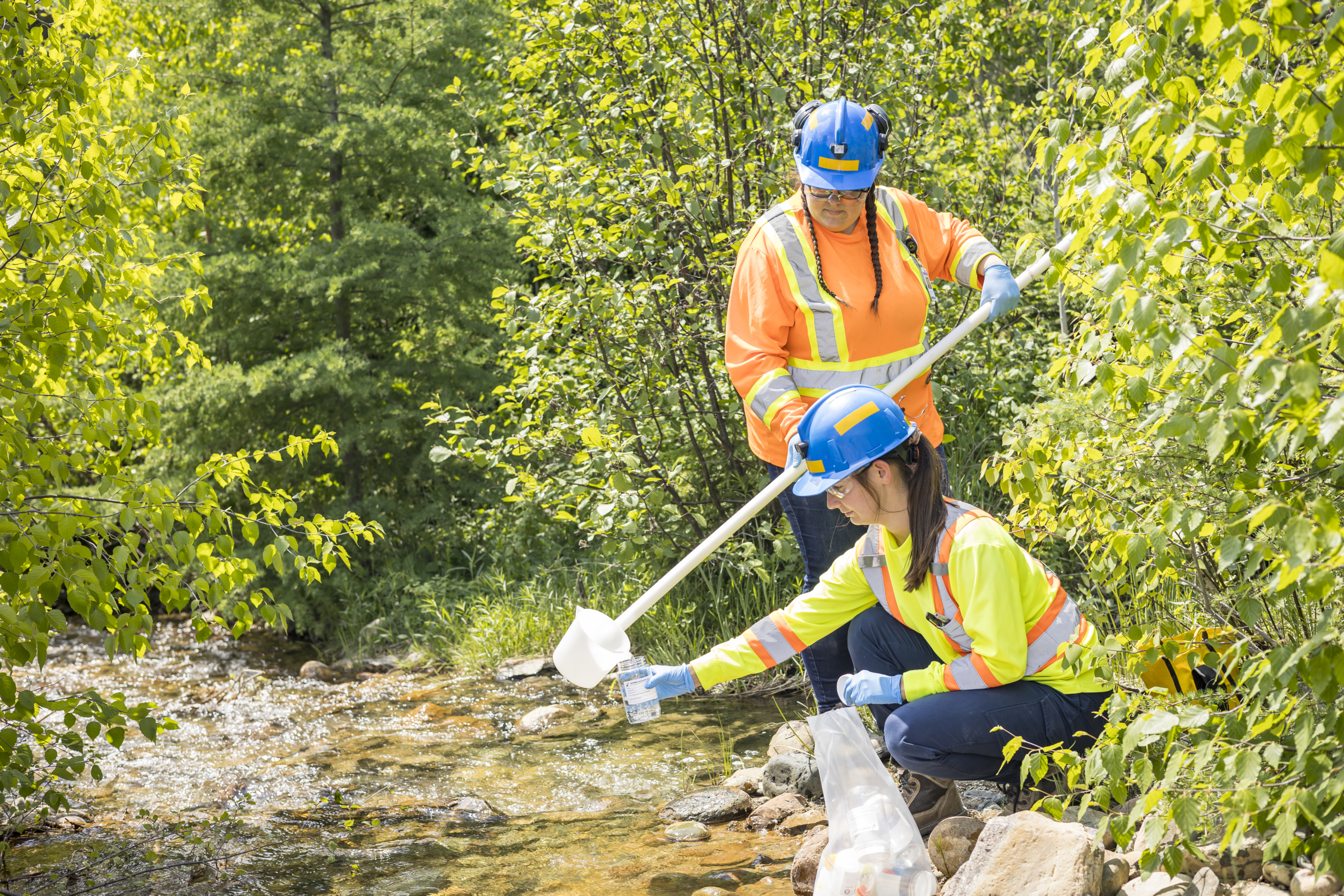
Detour Lake Mine monitors the surface and groundwater quality around the operation to ensure there is no adverse impacts on the environment. DLM has an extensive system of seepage and runoff collection ditches and infrastructure to ensure all contact water is collected and specific criteria are met prior to re-releasing back into the environment. Surface and groundwater monitoring involves the collection and analysis of water samples from lakes, watercourses and groundwater wells on and off-site. Over 250 sample locations are visited multiple times per year. The samples are collected at regular intervals and analyzed for various parameters, including but not limited to; temperature, pH, dissolved oxygen, turbidity, and metals.
Air Quality Monitoring
Air Quality around the mine site is monitored to ensure the dust and emissions generated from the site do not have an adverse impact on the surrounding environment. Monitoring evaluates the levels of suspended particulate matter, metals, dustfall, sulphur dioxide (SO2) and nitrogen dioxide (NO2). There are two regulatory air quality monitoring stations located onsite. Air sampling occurs at regular intervals throughout the year to evaluate the success of mitigation measures.
Aquatics Monitoring
Detour Lake Mine is located in an environment of discontinuous wetlands, therefore monitoring of aquatic environments is critical to the organization and local land users. Aquatics monitoring is conducted within all waterbodies surrounding the operations to evaluate the health and abundance of, fish species, benthic invertebrates and sediment. Common species found around DLM are Northern Pike, Walleye, Burbot, White Sucker and Yellow Perch.
Terrestrial Monitoring
Terrestrial monitoring for wildlife and wildlife habitat has been ongoing since baseline studies originally commenced in 2008. Monitoring includes surveys to evaluate avian species, Woodland Caribou and other terrestrial mammals. Surveys aim to evaluate the distribution and abundance of the wildlife around the DLM. As Woodland Caribou are listed as a species at risk a large focus is put on monitoring the Kesagami herd, for which DLM is within their range. Surveys are undertaken to assess changes in winter distribution, demography, calf recruitment and relative abundance trends of Woodland Caribou in proximity of DLM throughout the construction, operation and closure phases of the mine.
Hydrological Monitoring
Hydrological monitoring takes place at Detour Lake Mine to measure stream flows, and water levels in the surrounding lakes and creeks. Hydrological monitoring is also used evaluate changes to local hydrological regimes as a result of natural or mine related processes and to understand the site water balance which is used to informs decisions on when to release water back into the natural environment.
Habitat Reclamation
Throughout operations DLM aims to complete progressive habitat restoration on available mine infrastructure. To support ongoing reclamation and prepare for closure a 10-hectare test cover area was developed in 2019 and is monitored yearly to provide direction on future restoration efforts with respect to cover thickness, slope angles, vegetation species cover etc. Each year an average of 10 ha is reclaimed on site using available soil from the open pit and locally sourced seeds and shrubs. DLM also partners with several Academic institutions to support closure research to ensure when the mine closes the landscape will return to a naturally functioning ecosystem, with a focus on redeveloping Caribou habitat.
University Research
Detour has partnered with Academic Institutions on research projects since 2012. Research is focused on topics that will inform the site reclamation and closure planning. Some of the ongoing research projects include:
• Evaluation of practical methods for restoring native plant communities and the soil microbiome on a mine site;
• Use of lichen and biological soil crusts in restoration efforts;
• Characterization and reclamation of mining waste stockpiles;
• Mine tailings revegetation to evaluate the efficacy and performance of various plants and potential bioavailability of metals; and
• Effects of road habitat restoration on predators and prey species.
Surface and Groundwater Monitoring
Macassa closely monitors surface and groundwater by collecting samples from nearby watercourses and groundwater wells on and off-site. Over 70 sample locations are regularly visited throughout the year and analyzed for multiple parameters, including temperature, pH, turbidity, and metals.
Hydrological Monitoring
Hydrological monitoring takes place at Macassa to measure stream flows, and groundwater elevations. This data is reviewed to evaluate the water table level in relation to underground workings, and to understand the site water balance and ensure water management is implemented to save and reuse water where possible.
Air Quality Monitoring
Air Quality Monitoring includes measurement of suspended particulate matter, metals, and dustfall. There are six regulatory air quality monitoring stations located both on and off-site. Two high-volume stations, and four dustfall jars. Air sampling occurs at regular intervals throughout the year and is reported quarterly to the Ontario Ministry of the Environment, Conservation and Parks (MECP).
Fisheries Monitoring
Macassa participates in Federal Environmental Effects Monitoring, which includes testing of water quality, sublethal toxicity testing, and biological monitoring of fish and benthic communities. This is to ensure that effluent leaving site is of sufficient quality to protect fish and their natural habitat. This is reported to the Environment and Climate Change Canada on a quarterly and annual basis.
Terrestrial Monitoring
Baseline studies are conducted at Macassa to document the biodiversity in the area. Aquatic studies focus on fish habitat while terrestrial studies include vegetation, wildlife surveys for breeding birds, mammals, reptiles, amphibians, and potential species at risk. Macassa has two species at risk that have been identified: Canada warbler and the common nighthawk. Impacts on terrestrial biodiversity are monitored to ensure habitats are protected for all species.
Community Impact Monitoring
Macassa is equipped with multiple devices on and off-site that monitor noise and vibration. This is to ensure operational sounds and vibrations are not impacting nearby residing community members. Noise and vibration monitoring can be monitored in real time and operate all year round.